

Is DataCamp worth it for learning SQL in 2026? After using the platform myself and building SQL-driven Power BI reports for clients, here’s my honest DataCamp SQL review: yes, DataCamp is one of the best platforms for learning SQL — especially if you’re a beginner or career changer who wants structured, interactive practice. However, it has real limitations that most reviews won’t mention. In this updated DataCamp SQL review for 2026, I cover the courses, certification, pricing, and whether the subscription is actually worth your money.
I work as a freelance Power BI developer for clients in the US and Germany. Additionally, SQL is a tool I use every day — from writing queries in SSMS to building data models. So this isn’t just a surface-level DataCamp SQL review. It’s a practitioner’s take on whether DataCamp’s SQL courses can actually help you build job-ready skills.
- DataCamp SQL courses are worth it for beginners and career changers who want interactive, hands-on SQL practice with instant feedback — all under one $13/month subscription.
- The platform offers three SQL tracks (Fundamentals, Business Analysts, Associate Certification) covering 20–35 hours of structured content with real datasets.
- However, DataCamp SQL certification expires after 24 months and won’t replace a strong portfolio when job hunting.
- In 2026, free tools like ChatGPT and SQLBolt can also teach SQL basics. Consequently, DataCamp’s advantage is structure, accountability, and interactive coding environments.
- A flash sale running April 6–23 brings the annual cost down to roughly $78 — the best time to try DataCamp SQL.
DataCamp SQL Review: Quick Verdict for 2026
DataCamp is one of the best platforms for learning SQL if you’re a beginner or career changer. For $13/month billed annually ($156/year), you get access to 20+ SQL courses, structured career tracks, and a certification program — all with interactive browser-based coding. With over 17 million learners and a 4.6/5 Trustpilot rating, DataCamp is the most popular interactive SQL learning platform available. As a result, you can start writing real SQL queries within minutes without installing anything locally.
That said, DataCamp SQL has clear limitations. The exercises are sometimes too guided — the “fill in the blank” format doesn’t fully prepare you for real-world data work. Moreover, the SQL Associate Certification expires after 24 months, and no employer has ever asked me for one. So is DataCamp SQL worth it? For building a foundation, absolutely. For advanced SQL or database administration, you’ll need to look elsewhere.
“DataCamp SQL won’t make you an expert overnight. But it gives you structured, interactive practice across real datasets — and that foundation is genuinely hard to build on your own.”
What Is DataCamp SQL? Platform Overview
DataCamp is an interactive online learning platform focused on data science, analytics, and AI — with SQL as one of its strongest subject areas. Founded in 2013 and serving over 17 million learners worldwide, the platform offers 20+ dedicated SQL courses organized into career tracks. Unlike video-heavy platforms, DataCamp emphasizes writing actual code from the first lesson.
How DataCamp SQL Works
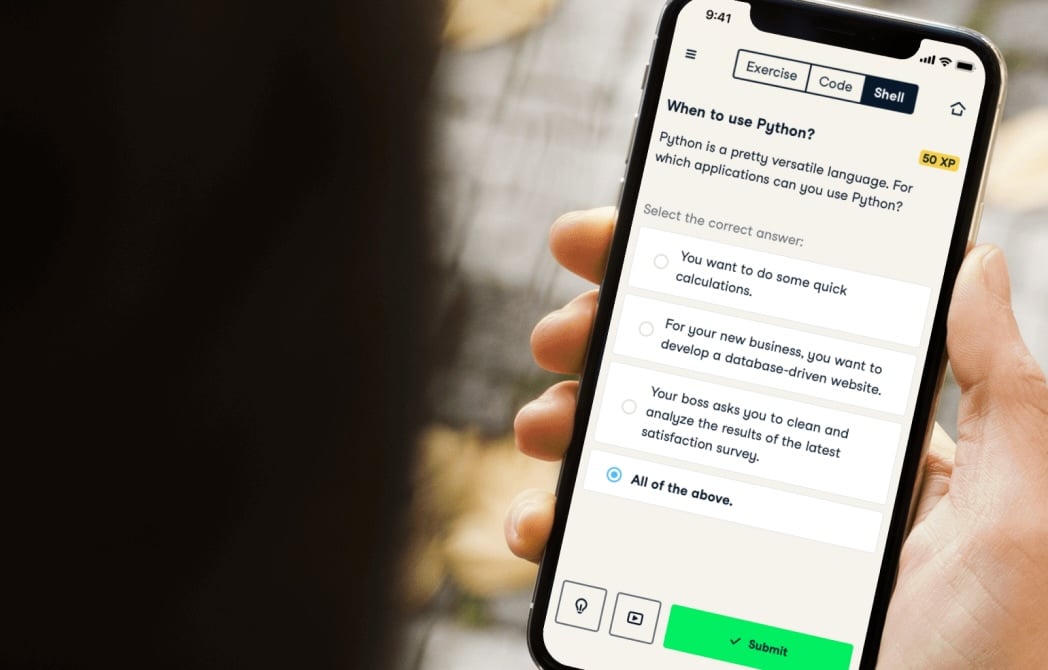
The core difference is interactivity. Specifically, every DataCamp SQL lesson follows a pattern: watch a short video (2–4 minutes), then immediately write SQL queries in a browser-based console. The platform provides instant feedback, hints when you’re stuck, and explanations for common errors. Consequently, you build muscle memory faster than with passive video watching.
In particular, DataCamp’s SQL environment supports multiple dialects including PostgreSQL, MySQL, SQL Server, and SQLite. You work with real datasets from organizations like NASA and FIFA — not toy examples. As a result, the practice feels closer to actual work than most alternatives.
DataCamp SQL Review: Key Numbers (2026)
| Metric | Value |
|---|---|
| Total SQL courses | 20+ |
| Learners in Intro to SQL | 735,000+ |
| SQL dialects covered | PostgreSQL, MySQL, SQL Server, SQLite |
| Career tracks with SQL | 3 dedicated + Data Analyst, Data Scientist tracks |
| Trustpilot rating | 4.6/5 stars |
DataCamp SQL Course Review: Tracks and Career Paths
DataCamp organizes its SQL courses into three primary tracks, each targeting specific career outcomes. Understanding the differences helps you choose the right path based on your goals and current skill level. Here’s the complete breakdown of each DataCamp SQL track for 2026.
SQL Fundamentals Track
The SQL Fundamentals track is the starting point for most learners. This 20-hour program covers everything from basic SELECT statements to window functions. Specifically, it includes five courses:
- Introduction to SQL: Basic syntax, SELECT statements, and database concepts
- Intermediate SQL: Filtering, sorting, grouping, and subqueries
- Joining Data in SQL: INNER, LEFT, RIGHT, and FULL OUTER joins
- Data Manipulation in SQL: INSERT, UPDATE, DELETE, and CREATE TABLE operations
- Summary Stats and Window Functions: Advanced analytics and reporting functions
SQL for Business Analysts Track
The SQL for Business Analysts track focuses on practical business applications. Additionally, this 20-hour specialization teaches you how to extract insights, calculate KPIs, and build SQL-based reports for stakeholders. It’s ideal if you’re already in a business role and need SQL to support data-driven decisions.
DataCamp SQL Associate Certification Track
The SQL Associate Certification track combines both fundamentals and business applications into a comprehensive 25–35 hour program. Moreover, it prepares you for DataCamp’s timed and practical certification exams. For a detailed look at whether the certification itself is worth pursuing, see the section below.
| SQL Track | Duration | Best For | Difficulty |
|---|---|---|---|
| SQL Fundamentals | 20 hours | All data roles | Beginner → Intermediate |
| SQL for Business Analysts | 20 hours | Analysts / BI roles | Intermediate |
| SQL Associate Certification | 25–35 hours | Career changers / credentialing | Intermediate → Advanced |
DataCamp SQL Certification Review: Is It Worth It?
The DataCamp SQL Associate Certification validates practical SQL skills through two exams — but it expires after 24 months and won’t replace a strong portfolio. Understanding the real value of this certification requires looking beyond DataCamp’s marketing to actual hiring practices. In this section of my DataCamp SQL review, I’ll break down exactly what you get.
How the Certification Works
DataCamp’s SQL certification consists of two assessments you must pass within 30 days of registration:
- Timed Exam (SQ101): A 60-minute multiple-choice assessment covering SQL theory, database design, and data management. Most students complete it in approximately 45 minutes.
- Practical Exam (SQ501P): A 4-hour hands-on coding assessment where you write complex queries against real datasets. You get two attempts.
The certification is included with your premium subscription — no additional cost. However, it expires after 24 months, so you’ll need to recertify periodically.
What Employers Actually Think
Indeed, this is the uncomfortable truth. According to Dataquest’s interviews with 15 data science hiring managers, none mentioned certificates as primary hiring criteria. In my own freelance consulting work, no client has ever asked whether I have a DataCamp certification. What matters instead is demonstrated skill: a portfolio of projects, practical SQL ability during interviews, and a well-positioned LinkedIn presence.
Nevertheless, the certification adds value in specific situations: entry-level job applications, career transitions where you need proof of SQL competency, and internal promotions where formal credentials carry weight.
“DataCamp SQL certification proves you completed structured assessments — but it won’t get you hired on its own. Portfolio projects and practical problem-solving are what employers actually evaluate.”
What DataCamp SQL Won’t Teach You
DataCamp SQL courses focus on querying and basic data manipulation — not database administration, advanced optimization, or production-level SQL engineering. Before subscribing, it’s important to understand these gaps so you can plan accordingly. Most DataCamp SQL reviews skip this part.
Topics NOT Covered in DataCamp SQL
- Database administration: No content on backups, user management, permissions, or server configuration
- Advanced query optimization: Execution plans, indexing strategies, and performance tuning are absent
- NoSQL databases: MongoDB, Cassandra, and other non-relational systems aren’t part of the SQL tracks
- ETL pipelines: Building production data pipelines with SQL is not covered in depth
- BI tool integration: How SQL connects to Power BI, Tableau, or Looker isn’t taught. For that, check my DataCamp Power BI review
Real-World Data Is Messier Than Exercises
DataCamp exercises use clean, pre-formatted datasets. In practice, data professionals typically spend 60–80% of their time cleaning and preparing data, handling missing values, and figuring out why two tables don’t join properly. Consequently, completing DataCamp SQL courses alone doesn’t make you job-ready. You need to supplement with your own projects using real, imperfect data.
As a consequence, treat DataCamp as your starting point — not the destination. At some point, you need to install a local SQL environment (like SQL Server Management Studio), work with messy real data, and build portfolio projects.
DataCamp SQL Review: My Personal Experience
I used DataCamp early in my data career, and it was one of the best learning investments I made. As someone who now writes SQL daily for Power BI data models and client reporting, I can speak to how DataCamp’s SQL education holds up in practice.
What I Liked About DataCamp SQL
Above all, the structure is what sold me. DataCamp doesn’t just throw content at you — it builds a learning path that makes sense. Each course follows a pattern: short video, then immediately write code. As a result, you retain concepts faster than with passive video watching.
I especially liked that you don’t need to install anything locally. For SQL, the browser-based environment means you’re writing real queries within minutes of starting. Similarly, the range of tools you can learn under one subscription — SQL, Python, Power BI, Tableau — made it easy to explore different career directions without paying per course. If you want a broader perspective, check my full DataCamp review.
What I Found Limiting About DataCamp SQL
However, DataCamp’s SQL exercises are sometimes too guided. The “fill in the blank” format helps beginners, but it doesn’t prepare you for writing queries from scratch — which is what you’ll do in a real job. In real projects, nobody gives you pre-written code with one line missing.
Furthermore, the platform dependency is a real issue. Because everything runs in DataCamp’s browser environment, you don’t learn how to set up your own development environment. Therefore, you’ll eventually need to transition to working with SQL Server, PostgreSQL, or MySQL locally.
“DataCamp SQL gave me structured exposure to query writing, joins, and window functions. That foundation — learning SQL syntax interactively rather than from a textbook — was the real value.”
DataCamp SQL Review: Pricing in 2026
DataCamp Premium costs $13/month when billed annually ($156/year) or $19/month for monthly billing. One subscription covers all SQL courses, the certification program, and 670+ additional courses across Python, Power BI, Tableau, and AI. When evaluating this DataCamp SQL review’s pricing section, keep in mind that you’re not paying per course — one subscription covers everything.
DataCamp SQL Pricing Breakdown
| Plan | Cost | What You Get |
|---|---|---|
| Free | $0 | First chapter of every SQL course, limited access |
| Premium (Annual) | $13/month ($156/year) | All SQL tracks, certification, 670+ courses, DataLab AI |
| Premium (Monthly) | $19/month | Same access — more flexible, higher total cost |
| Teams | $28/user/month (annual) | Premium + team management and analytics |
DataCamp SQL Review: Is the ROI Worth It?
To put the pricing in perspective, consider the alternatives. University SQL courses cost $3,000–15,000 per semester. Data science bootcamps run $10,000–20,000. Even individual Udemy courses cost $15–50 each. At $156/year, DataCamp gives you unlimited access to SQL plus every other topic on the platform.
Now imagine the return on investment. According to ZipRecruiter’s 2026 data, the average SQL data analyst salary in the US is $107,413/year — with the 75th percentile reaching $133,914. Meanwhile, the U.S. Bureau of Labor Statistics projects demand for data-centric roles to grow 23–35% by 2032. At $156/year, even a modest $5,000 salary increase from learning SQL represents a 32x return. Accordingly, the investment is almost negligible compared to the potential upside.
Build job-ready data and AI skills — 50% off all premium plans. Upskill in SQL, Python, Power BI, Tableau, and more. 600+ interactive courses, career tracks, and industry-leading certifications at half price.
At 50% off, the annual plan drops to roughly $78/year ($6.50/month). If you’ve been considering DataCamp SQL, this is the best time to start.
Get 50% Off DataCamp →Sale ends April 23, 2026 at 11:59 PM EST. Check the latest DataCamp promo codes for additional discounts.
DataCamp SQL Review vs Udemy, Coursera, and Free Alternatives
DataCamp wins on SQL-specific interactivity and price. Udemy wins on lifetime access. Coursera wins on academic depth. Free tools win on cost — obviously. Overall, your best choice depends on your learning style and budget. This DataCamp SQL review wouldn’t be complete without a fair comparison.
DataCamp SQL vs Udemy
The fundamental difference: DataCamp provides interactive coding with instant feedback, while Udemy relies on video lectures. For SQL specifically, interactive practice is more effective because SQL is a doing skill — you learn by writing queries, not by watching someone else write them. However, Udemy offers lifetime access per course and often has steeper discounts (courses frequently drop to $10–15).
DataCamp SQL vs Coursera
Coursera offers university-level SQL content from institutions like Google and IBM, with certificates that carry more academic weight. However, Coursera Plus costs $59/month ($399/year) — over 2.5x more than DataCamp. If you specifically want an employer-recognized credential, Coursera’s Google Data Analytics Certificate is stronger. If you want hands-on SQL practice at a lower cost, DataCamp is the better choice.
DataCamp SQL vs Free Alternatives
| Platform | Cost | Interactive SQL | Structured Path | Certificate |
|---|---|---|---|---|
| DataCamp | $13/mo annual | Excellent | Excellent | Yes (24-month validity) |
| W3Schools SQL | Free | Basic (Try It editor) | Minimal | Paid ($95) |
| SQLBolt | Free | Good (in-browser) | Good (18 lessons) | No |
| Kaggle Learn SQL | Free | Good (notebooks) | Good (5 courses) | Yes (free) |
| YouTube / ChatGPT | Free | None / Q&A only | None | No |
| Udemy | $10–50 per course | Limited | Per course only | Yes (completion) |
| Coursera Plus | $59/mo annual | Limited | Excellent | Yes (university-backed) |
The bottom line: free alternatives are excellent if you’re self-motivated. DataCamp SQL is worth it when you need structure, interactive feedback, and a guided path. For most beginners, that guidance is worth $13/month. If you’re curious how DataCamp’s broader platform compares, see my full “Is DataCamp Worth It?” review.
DataCamp SQL Review: Pros and Cons
After testing the platform and analyzing hundreds of user reviews, here’s my balanced DataCamp SQL review of what works and what doesn’t. These are the honest pros and cons you should weigh before subscribing.
DataCamp SQL Pros
- Interactive coding from day one: Write real SQL queries with instant feedback — no setup required
- Structured career tracks: Clear progression from beginner to certification-ready in 2–4 months
- Real datasets: Practice with data from NASA, FIFA, and other recognizable organizations
- Multiple SQL dialects: Learn PostgreSQL, MySQL, and SQL Server with transferable concepts
- One subscription covers everything: SQL, Python, Power BI, Tableau, AI — all included at $13/month
- DataLab AI assistant: Get personalized help and code explanations when stuck
- Mobile learning: Practice SQL concepts on your phone during commutes
DataCamp SQL Cons
- Fill-in-the-blank exercises: Too guided — doesn’t fully prepare you to write queries from scratch
- Limited advanced content: Experienced SQL users will find intermediate+ content too basic
- Platform dependency: You don’t learn to set up your own SQL environment
- Certification expires: The SQL Associate Certificate is valid for only 24 months
- No offline practice: All interactive exercises require an internet connection
- Simplified data scenarios: Real-world data is messier and more complex than course exercises
- No database administration: Focused on querying, not managing databases
Who Should Choose DataCamp for SQL?
DataCamp SQL is ideal for beginners and career changers who want a structured, affordable entry point into SQL. It’s less suitable for advanced practitioners or those who can learn effectively from free resources. Here’s a breakdown by career stage to help you decide.
DataCamp SQL Is Worth It If You:
- Are a beginner with little or no SQL experience looking for guided, interactive learning
- Want to learn multiple tools (SQL, Python, Power BI) under one subscription
- Prefer writing code over watching video lectures
- Need structured career tracks that tell you what to learn in what order
- Are changing careers and need to build a SQL foundation quickly. Additionally, check these 73 Power BI interview questions to prepare for data role interviews
DataCamp SQL Might Not Be Worth It If You:
- Already have intermediate or advanced SQL skills
- Are highly self-disciplined and can learn from free tools like SQLBolt and Kaggle Learn
- Need deep database administration or performance tuning content
- Prefer one-time purchases over recurring subscriptions (consider Udemy instead)
- Want a certificate that carries weight equal to a university credential (consider Coursera)
DataCamp SQL Review: Recommendations by Career Stage
| Career Stage | Suitability | Recommended Track | Timeline |
|---|---|---|---|
| Complete Beginner | Excellent | SQL Fundamentals | 3–4 months |
| Career Changer | Very Good | Business Analyst Track | 2–3 months |
| Current Analyst | Good | Certification Program | 1–2 months |
| Advanced User | Limited value | Specialized courses only | N/A |
Build job-ready SQL and data skills — 50% off all premium plans.
600+ interactive courses, career tracks, and industry-leading certifications.
Get 50% Off DataCamp →Sale runs April 6–23, 2026. No promo code needed.
Frequently Asked Questions
Is DataCamp SQL good for complete beginners?
Yes, DataCamp SQL is one of the best platforms for complete beginners. In particular, the interactive coding environment provides instant feedback, and the career tracks guide you step-by-step from zero knowledge to job-relevant SQL skills in 3–4 months.
How long does it take to complete DataCamp SQL Fundamentals?
The SQL Fundamentals track requires approximately 20 hours of study, which typically translates to 6–10 weeks if you study 2–4 hours per week. However, completion time varies based on your prior experience and study consistency.
Is the DataCamp SQL certification recognized by employers?
The DataCamp SQL certification is growing in recognition, particularly for entry-level analyst roles. However, most hiring managers prioritize portfolio projects and demonstrated SQL ability over certificates alone. Additionally, the certification expires after 24 months.
How much does DataCamp SQL cost in 2026?
DataCamp Premium costs $13/month billed annually ($156 total) or $19/month for monthly billing. Moreover, the certification is included — no additional cost. Furthermore, DataCamp runs regular flash sales with up to 50% off.
Is DataCamp SQL better than Udemy for learning SQL?
DataCamp is better for interactive SQL practice with instant feedback. Udemy is better if you want lifetime access to specific courses and prefer video-based learning. Overall, DataCamp offers more consistent quality and better hands-on coding practice for SQL specifically.
What SQL dialects does DataCamp teach?
DataCamp SQL courses primarily use PostgreSQL while covering concepts applicable to MySQL, SQL Server, and SQLite. Consequently, the focus is on standard SQL syntax that transfers across database systems rather than dialect-specific features.
Can I learn SQL for free instead of paying for DataCamp?
Yes — free alternatives like SQLBolt, W3Schools, and Kaggle Learn offer solid SQL basics. However, they lack the structured career tracks, interactive feedback, and certification that DataCamp provides. For self-disciplined learners, free tools may be sufficient. For most people, DataCamp’s structure is worth the $13/month investment.
Does DataCamp SQL help you get a data analyst job?
DataCamp SQL provides the foundational skills needed for data analyst roles, but it won’t guarantee employment on its own. Specifically, you’ll need to supplement with portfolio projects, networking, and interview preparation. For example, check these 73 Power BI interview questions to see what employers actually test.