
Is DataCamp worth it in 2026? As a freelance Power BI developer who used DataCamp early in my own career, I can give you an honest answer: yes, DataCamp is worth it — especially if you’re a beginner or career changer looking to learn data skills like Python, SQL, or Power BI. However, it comes with real limitations that most DataCamp reviews won’t tell you about. In this updated datacamp review 2026 edition, I’ll share what works, what doesn’t, and whether the subscription is actually a good investment for your career.
I’ve spent years working with Power BI, SQL, and data modeling for clients across the US and Germany. Additionally, I’ve tested DataCamp’s courses firsthand. So this isn’t just a surface-level datacamp review — it’s a practitioner’s perspective on whether DataCamp is good enough to build real job-ready skills, and what you’ll still need to learn elsewhere.
- DataCamp is worth it for beginners and career changers who want structured, interactive learning in Python, SQL, Power BI, and more — all under one subscription.
- At $13/month (billed annually), a single subscription covers 670+ courses across multiple tools. Consequently, you don’t pay per course like on Udemy.
- The browser-based coding environment means you don’t need to install anything locally — you can start learning immediately.
- However, DataCamp certificates alone won’t land you a job. Portfolio projects and personal branding matter more.
- In 2026, free AI tools like ChatGPT and Claude can also teach coding. DataCamp’s advantage is structure and accountability.
- If you get hired in a data role, the $156/year investment pays for itself many times over — making the return on investment significant.
My Quick Verdict: Is DataCamp Worth It in 2026?
DataCamp is worth it if you want a structured, hands-on way to learn data skills without spending thousands on a bootcamp or degree. For $13/month billed annually, you get access to 670+ courses covering Python, SQL, R, Power BI, Tableau, Excel, and even AI topics. As a result, one subscription replaces what would cost hundreds of dollars in individual courses on other platforms.
That said, DataCamp has real limitations. The exercises are guided — sometimes too guided. Moreover, the certificates carry less weight than a strong portfolio. And in 2026, free AI tools can answer many of the same coding questions DataCamp teaches. So is DataCamp good enough to justify the cost? In short, is datacamp subscription worth it? For most beginners, yes. For advanced practitioners, probably not.
“DataCamp won’t guarantee you a job. But it gives you structured exposure to real problems across multiple tools — and that foundation is hard to build on your own.”
What Is DataCamp? Platform Overview
DataCamp is an interactive online learning platform focused exclusively on data science, analytics, and AI education. Founded in 2013, the platform now serves over 14 million learners worldwide, including employees at companies like Google, Microsoft, and eBay. To understand whether is DataCamp worth it for you, it helps to know what the platform actually offers. Unlike traditional video-based courses, DataCamp emphasizes hands-on coding practice in browser-based environments with instant feedback.
What Makes DataCamp Different From Other Platforms
The core difference is interactivity. Specifically, on DataCamp you write actual code from the very first lesson. Furthermore, the platform provides real-time feedback, hints, and error explanations — so you’re never just passively watching someone else code. This approach builds muscle memory faster than video-only platforms.
In particular, DataCamp covers four primary technology areas that form the backbone of modern data roles:
- Python: From basics through machine learning and data manipulation with pandas
- SQL: Query writing, database design, and data extraction
- R: Statistical analysis, visualization, and research methods
- Business Intelligence: Power BI, Tableau, and Excel for data visualization and reporting
Additionally, DataCamp has expanded into AI and machine learning courses in 2026, covering topics like generative AI, large language models, and prompt engineering. As a result, the platform now covers the full spectrum of skills a modern data professional needs.
DataCamp Pricing in 2026: Is the Subscription Worth It?
DataCamp Premium costs $13/month when billed annually ($156/year) or $19/month if you prefer monthly billing. When deciding is DataCamp worth it, pricing is a key factor. There’s also a free tier that gives you the first chapter of every course — enough to test the platform before committing. For teams, pricing starts at $25 per user per month billed annually. You can check the latest rates on the official DataCamp pricing page.
DataCamp Pricing Breakdown
| Plan | Cost | What You Get |
|---|---|---|
| Free | $0 | First chapter of every course, limited access |
| Premium (Annual) | $13/month ($156/year) | 670+ courses, projects, certifications, DataLab AI, career tracks |
| Premium (Monthly) | $19/month | Same as annual — more flexible, higher total cost |
| Teams | $25/user/month (annual) | Everything in Premium + team management and analytics |
Why the Value for Money Is Hard to Beat
Here’s what makes DataCamp pricing genuinely compelling: one subscription covers everything. You’re not paying per course like on Udemy, where each course costs $15–50 individually. On DataCamp, $156/year gives you unlimited access to Python, SQL, Power BI, Tableau, R, Excel, AI, and machine learning courses. That flexibility is a major advantage.
To put that in perspective, consider the alternatives:
- University courses: $3,000–15,000 per semester
- Data science bootcamps: $10,000–20,000 for a 3–6 month program
- Udemy: $15–50 per individual course (and you need many)
- Coursera Plus: $49/month ($588/year)
- DataCamp Premium: $13/month ($156/year)
Now imagine the return on investment. If learning these skills helps you land a data analyst role paying $60,000–80,000, your $156 investment pays for itself hundreds of times over. Even a modest $5,000 salary increase represents a 32x return. Accordingly, the investment is almost negligible compared to the potential upside.
DataCamp is running a flash sale from April 6th to April 23rd, 2026 — that’s 50% off all premium plans. Build job-ready data and AI skills in Python, SQL, Power BI, Tableau, and more. 600+ interactive courses, career tracks, and industry-leading certifications — all at half price.
At 50% off, the annual plan drops to roughly $78/year ($6.50/month). That’s hard to beat for unlimited access to 670+ courses. If you’ve been wondering is DataCamp worth it, this is the best time to try it.
Get 50% Off DataCamp →Sale ends April 23, 2026 at 11:59 PM EST.
My Personal Experience With DataCamp
I used DataCamp early in my Power BI career, and it was one of the best learning investments I made. So is DataCamp worth it based on my personal experience? Absolutely — for where I was at the time. What I appreciated most wasn’t any single course — it was the breadth. With one subscription, I could jump between Power BI fundamentals, SQL queries, and Python basics without paying extra for each topic.
Why DataCamp Is Worth It: What I Liked
Above all, the structure is what sold me. DataCamp doesn’t just throw content at you — it builds a learning path that makes sense. Each course follows a pattern: short video explanation, then immediately practice what you just learned by writing code. As a result, you retain concepts faster than with passive video watching.
I especially liked that you don’t need to install anything locally. For Power BI courses, for example, everything runs on their remote machines. As a result, that removes a huge barrier for beginners who might struggle with software setup. Similarly, for SQL and Python, the browser-based environment means you’re writing real code within minutes of starting.
Another thing I love about DataCamp: the range of tools you can learn. One subscription gives you access to courses on Power BI, SQL, Python, R, Tableau, Excel, and now AI topics. Compare that to Udemy, where you’d pay $15–50 per course for each of those tools. On DataCamp, you can explore all of them and figure out what fits your career goals — without additional cost.
What I Found Limiting
However, DataCamp’s exercises are sometimes too guided. The “fill in the blank” format helps beginners, but it doesn’t fully prepare you for the messy reality of working with actual data. In real projects, nobody gives you pre-written code with one line missing.
Furthermore, no client has ever asked me for a DataCamp certificate. In my experience as a freelance consultant, what matters is your portfolio, your ability to solve problems, and your personal brand on platforms like LinkedIn. The certificate is nice to have, but it’s not what gets you hired.
“DataCamp gave me structured exposure to Power BI, SQL, and Python under one subscription. That breadth — learning multiple tools without paying per course — was the real value for me.”
Is DataCamp Worth It? What’s Good in 2026
DataCamp’s greatest strength in 2026 is its combination of interactive learning, broad course coverage, and accessible pricing. The platform has improved significantly over the years, and several features make it stand out from competitors in this datacamp review.
Interactive Learning That Actually Works
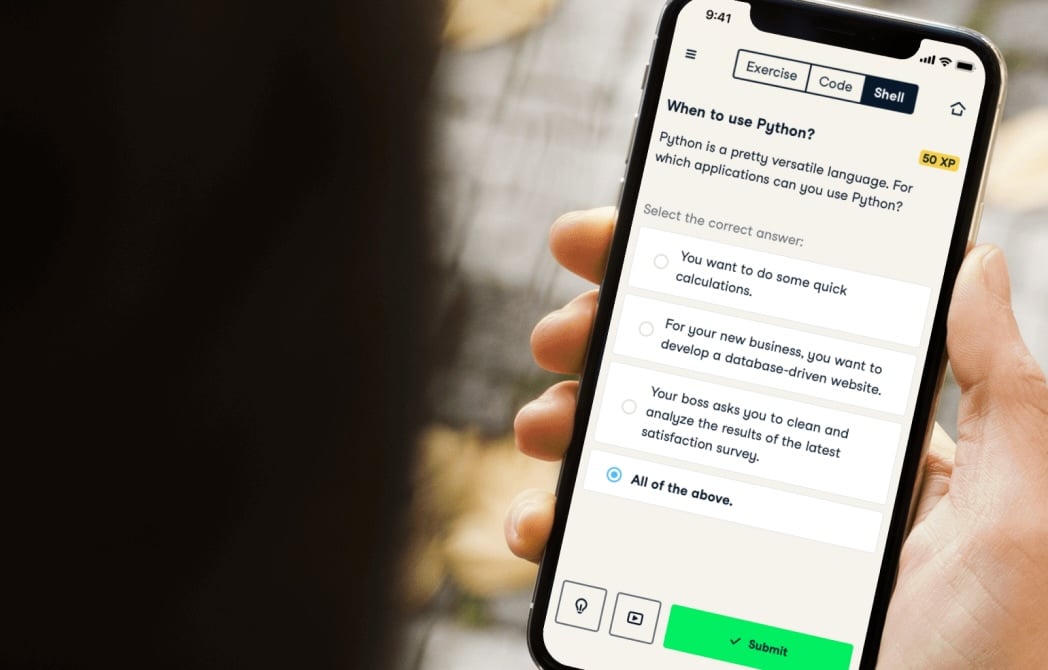
Every DataCamp course follows a learn-by-doing approach. You watch a short video (typically 2–4 minutes), then immediately write code in an integrated environment. The platform provides instant feedback, hints when you’re stuck, and explanations for common errors. Consequently, you build practical coding skills from day one rather than just watching someone else code.
The gamification elements — XP points, streaks, leaderboards — might seem superficial, but they genuinely help with consistency. Moreover, the daily 5-minute mobile challenges keep you engaged during busy weeks.
Structured Career and Skill Tracks
Rather than browsing hundreds of individual courses, DataCamp organizes content into career tracks that align with specific job roles. This structure is particularly helpful for beginners who don’t know where to start.
| If You Want This Role | Take This Track | Estimated Time |
|---|---|---|
| Data Analyst | Data Analyst with Python or SQL | 25–35 hours |
| Data Scientist | Data Scientist with Python | 40–50 hours |
| BI Analyst / Report Developer | Data Analyst in Power BI | 20–30 hours |
| Data Engineer | Data Engineer with Python | 35–45 hours |
| Machine Learning Engineer | Machine Learning Scientist with Python | 50–60 hours |
DataLab AI Assistant
DataLab is DataCamp’s integrated AI coding assistant, introduced to help learners get unstuck faster. It can generate code from natural language descriptions, explain errors, and suggest improvements. In effect, it acts like a personal tutor that understands the context of your current exercise.
However, keep in mind that free tools like ChatGPT and Claude can do much of the same. DataLab’s advantage is that it’s integrated directly into the exercise environment, so you don’t need to context-switch between tabs.
Power BI and SQL Courses: A Practitioner’s Take
As someone who builds Power BI reports professionally, I can speak to the quality of DataCamp’s BI courses specifically. The Power BI courses on DataCamp cover the fundamentals well — data modeling, basic DAX, visualization best practices. For beginners, they provide a solid starting point.
Similarly, the SQL courses are among DataCamp’s strongest offerings. SQL is the most in-demand skill for data roles, and DataCamp’s interactive SQL exercises are better than most alternatives. You write real queries against real datasets, which builds practical skills effectively.
That said, if you’re looking for advanced DAX patterns or enterprise-level Power BI development techniques, you’ll need to go beyond DataCamp. The platform covers fundamentals well, but the depth stops where professional-level consulting begins. For deeper Power BI knowledge, resources like Microsoft Learn and community blogs fill the gap.
What DataCamp Won’t Teach You
DataCamp is a learning platform, not a job placement service — and understanding that distinction is critical. Most DataCamp reviews gloss over the real limitations because they’re affiliate content. Before you decide is DataCamp worth it, here’s what you should know.
Real-World Data Is Messier Than Exercises
DataCamp exercises use clean, pre-formatted datasets. According to industry surveys, data professionals typically spend 60–80% of their time cleaning and preparing data, handling missing values, and figuring out why two tables don’t join properly. As a consequence, completing DataCamp courses alone doesn’t make you job-ready. You need to supplement with your own projects using real, imperfect data.
Certificates Don’t Get You Hired
Indeed, this is the uncomfortable truth most reviews avoid. DataCamp certificates prove you completed exercises — they don’t prove you can solve real business problems. In my experience working with hiring managers and clients, nobody has ever asked specifically for a DataCamp certificate. What matters instead is demonstrated skill: a portfolio of projects, a GitHub profile, or a well-positioned LinkedIn presence.
Platform Dependency Is a Risk
Because everything runs in DataCamp’s browser environment, you don’t learn how to set up your own development environment. As a consequence, you’ll eventually need to install Python, configure a local SQL server, or set up Power BI Desktop. Therefore, treat DataCamp as a starting point — not the destination. At some point, you need to transition to working in your own local setup.
“DataCamp teaches you the syntax and concepts. But the gap between finishing a DataCamp course and being productive in a real job is something you’ll need to bridge yourself — through portfolio projects and hands-on practice.”
Is DataCamp Worth It vs Free Alternatives in 2026?
The biggest question in 2026 isn’t “DataCamp vs Coursera” — it’s “DataCamp vs free.” With YouTube tutorials, freeCodeCamp, Kaggle Learn, Microsoft Learn, and AI chatbots all available for $0, why pay $156/year? Here’s the honest comparison.
Is DataCamp Worth It vs ChatGPT and Claude?
In 2026, you can ask ChatGPT or Claude to teach you Python, explain SQL joins, or walk you through DAX formulas — completely free. In fact, these AI tools are remarkably good at answering coding questions and generating practice exercises on the fly.
So why would anyone pay for DataCamp? Because structure and accountability are worth paying for. AI chatbots give you answers, but they don’t give you a curriculum. They don’t track your progress, they don’t gamify your learning streaks, and they don’t build gradually from basic to advanced concepts. For self-disciplined learners, AI tools might be enough. For most people, DataCamp’s structured approach prevents the “I’ll start tomorrow” loop.
In practice, the best approach is to use both. Take DataCamp courses for structure, and use ChatGPT or Claude when you get stuck or want to explore a concept deeper.
DataCamp vs YouTube, freeCodeCamp, and Kaggle Learn
| Factor | DataCamp | YouTube | freeCodeCamp | Kaggle Learn |
|---|---|---|---|---|
| Cost | $13/mo annual | Free | Free | Free |
| Structured curriculum | Excellent | None | Good | Good |
| Interactive coding | Yes (in-browser) | No | Yes | Yes (notebooks) |
| Instant feedback | Yes | No | Limited | Yes |
| Certificates | Yes | No | Yes (free) | Yes (free) |
| Data science focus | Dedicated | Mixed | Broad (web dev focus) | Dedicated |
| Progress tracking | Detailed | None | Basic | Basic |
The bottom line: free alternatives are excellent if you’re self-motivated and know exactly what to learn. DataCamp is worth it when you need structure, want instant feedback, and prefer a guided path from beginner to job-ready. For most people just starting out, that guidance is worth $13/month. So when people ask is DataCamp worth it compared to free options, the answer is usually yes — unless you’re exceptionally self-disciplined.
DataCamp vs Coursera vs Codecademy: Which Is Worth It?
DataCamp wins on data science specialization and price. Coursera wins on academic depth. Codecademy wins on general programming breadth. Overall, is DataCamp worth it compared to these alternatives? The right choice depends on what you’re trying to learn and how you prefer to learn it.
| Factor | DataCamp | Coursera | Codecademy |
|---|---|---|---|
| Monthly cost (annual) | $13/month | $49/month (Plus) | $35/month (Pro) |
| Learning style | Interactive coding | Video lectures + assignments | Interactive coding |
| Best for | Data science & analytics | Academic depth, university certs | General programming |
| Content depth | Good (practical focus) | Excellent (academic) | Good (practical) |
| Certificate recognition | Growing | Strong (university-backed) | Moderate |
| Speed to job-ready skills | Fast (3–6 months) | Slow (6–12 months) | Moderate (4–8 months) |
When to Choose Each Platform
Choose DataCamp if you specifically want data science, analytics, or BI skills. It’s the most affordable option and gets you coding immediately. In particular, the one-subscription-covers-everything model means you can explore SQL, Python, Power BI, and Tableau without paying extra.
Choose Coursera if you want university-level depth and academic credentials. Coursera’s Google Data Analytics and IBM Data Science certificates carry more weight with traditional employers. However, you’ll pay 3–4x more than DataCamp.
Choose Codecademy if your interests span beyond data science into web development or software engineering. Codecademy has broader programming coverage but less data science specialization.
Are DataCamp Certificates Worth It?
DataCamp certificates are worth earning but not worth relying on as your primary job qualification. Many people asking is DataCamp worth it focus on the certificates — but they don’t carry the same weight as a university degree or a recognized industry certification like the Microsoft PL-300.
What Employers Actually Look For
The hiring landscape has shifted significantly toward skills-based evaluation. Accordingly, what matters most is demonstrating practical ability — not collecting certificates. Here’s what I’ve seen work in my own career and in conversations with other data professionals:
- Portfolio projects: A well-documented Power BI report or Python analysis on GitHub speaks louder than any certificate
- Practical assessments: Most employers give you a take-home data task during interviews — your DataCamp skills help here, but the certificate doesn’t. For example, check these 73 Power BI interview questions to see what employers actually test
- Personal branding: An active LinkedIn presence sharing data insights builds credibility faster than listing certificates
- Continuous learning signals: Certificates do show commitment to skill development, which some employers value as a positive signal
Is DataCamp Certification Worth It? My Honest Take
In my freelance consulting work, no client has ever asked whether I have a DataCamp certificate. They ask to see my past reports, my approach to solving their problem, and my availability. Nevertheless, DataCamp certificates are still a useful stepping stone — they give you structure and milestones to work toward. Just don’t treat them as a golden ticket.
In other words, the real value of DataCamp isn’t the piece of paper at the end. It’s the skills you build along the way and how you apply them in your own projects afterward.
Who Should (and Shouldn’t) Use DataCamp
DataCamp is ideal for beginners and career changers who want a structured, affordable entry point into data skills. It’s less suitable for advanced practitioners or those with very tight budgets who can leverage free alternatives effectively.
DataCamp Is Worth It If You:
- Are a beginner with little or no programming experience looking for guided learning
- Want to learn multiple tools (Python, SQL, Power BI, Tableau) under one subscription
- Prefer interactive coding over passive video watching in your data science courses
- Need structured career tracks that tell you what to learn and in what order
- Want to try courses before committing (free first chapters for every course)
- Are changing careers and need to build a foundation across several data skills quickly
DataCamp Might Not Be Worth It If You:
- Already have intermediate or advanced data skills and need specialized content
- Prefer deep theoretical foundations over practical exercises (consider Coursera instead)
- Are highly self-disciplined and can learn effectively from free YouTube tutorials and AI chatbots
- Need offline coding practice — DataCamp requires an internet connection for exercises
- Want a certificate that carries weight equal to a university credential
For those interested in Power BI specifically, you might also find my guide to Power BI dashboard design best practices helpful as a complement to what DataCamp teaches. If you’re still wondering is DataCamp worth it for your situation, the next section breaks it down by learner type.
Build job-ready data and AI skills — 50% off all premium plans.
Upskill in Python, SQL, Power BI, Tableau, and more. 600+ interactive courses, career tracks, and industry-leading certifications.
Get 50% Off DataCamp →Sale runs April 6–23, 2026. No promo code needed.
Frequently Asked Questions
Is DataCamp worth it for complete beginners with no coding experience?
Yes, DataCamp is one of the best platforms for complete beginners. In particular, the interactive coding environment provides instant feedback, so you don’t need any prior setup or experience. Additionally, the career tracks guide you step-by-step from zero knowledge to job-relevant skills in 3–6 months.
How much does DataCamp cost in 2026?
DataCamp Premium costs $13/month when billed annually ($156 total) or $19/month for monthly billing. Moreover, there’s a free tier with limited access to first chapters. Furthermore, DataCamp regularly offers flash sales with up to 50% off, which brings the annual cost down to approximately $78.
Are DataCamp certificates recognized by employers?
DataCamp certificates are recognized as evidence of practical skills, but they carry less weight than university degrees or industry certifications like the Microsoft PL-300. As a result, most hiring managers prioritize portfolio projects and demonstrated coding ability over certificates alone. However, certificates can serve as a positive signal of continuous learning.
Can I use DataCamp without an internet connection?
No. DataCamp requires an active internet connection for all interactive coding exercises. Only theoretical content like videos and explanations can be accessed offline through the mobile app. Consequently, if you frequently travel without reliable internet, this is a significant limitation to consider.
Is DataCamp better than Coursera for learning data science?
It depends on your learning style. DataCamp is better for hands-on, interactive coding practice and costs significantly less ($13/month vs $49/month). On the other hand, Coursera offers deeper academic content from universities and more widely recognized certificates. For practical skill building on a budget, DataCamp is the stronger choice. For theoretical depth, Coursera wins.
Does DataCamp actually help you get a data analyst job?
DataCamp provides the foundational skills needed for data roles, but it doesn’t guarantee employment on its own. Specifically, you’ll need to supplement DataCamp learning with portfolio projects, networking, and interview preparation. In my experience, the skills DataCamp teaches are directly relevant to data analyst work — the platform just can’t replace the effort of building a professional profile and applying strategically.