
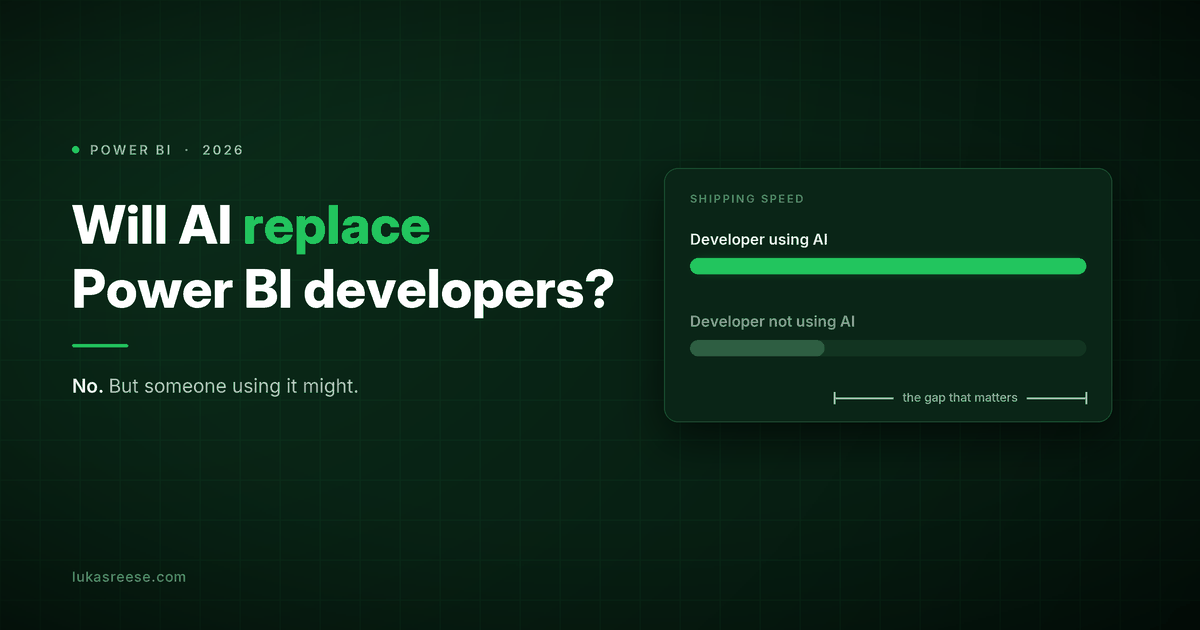
Will AI replace Power BI developers? No. However, I want to give you the uncomfortable version of that answer rather than the reassuring one, because the reassuring version is what most articles on this question are selling.
The framing itself is the problem. Specifically, almost everyone argues about human versus machine, when the version of this risk that actually shows up in careers looks nothing like that. Rather than a robot taking your desk, it looks like a colleague who ships in a third of the time. Consequently, that is what this article is about, along with the two things that genuinely protect you.
See what AI actually does in my Power BI work
My free guide shows my exact workflow, where the agent helps and where I still decide: 25 pages, 7 prompts you can copy, and the PBIP file.
How I Build Power BI Reports with AI
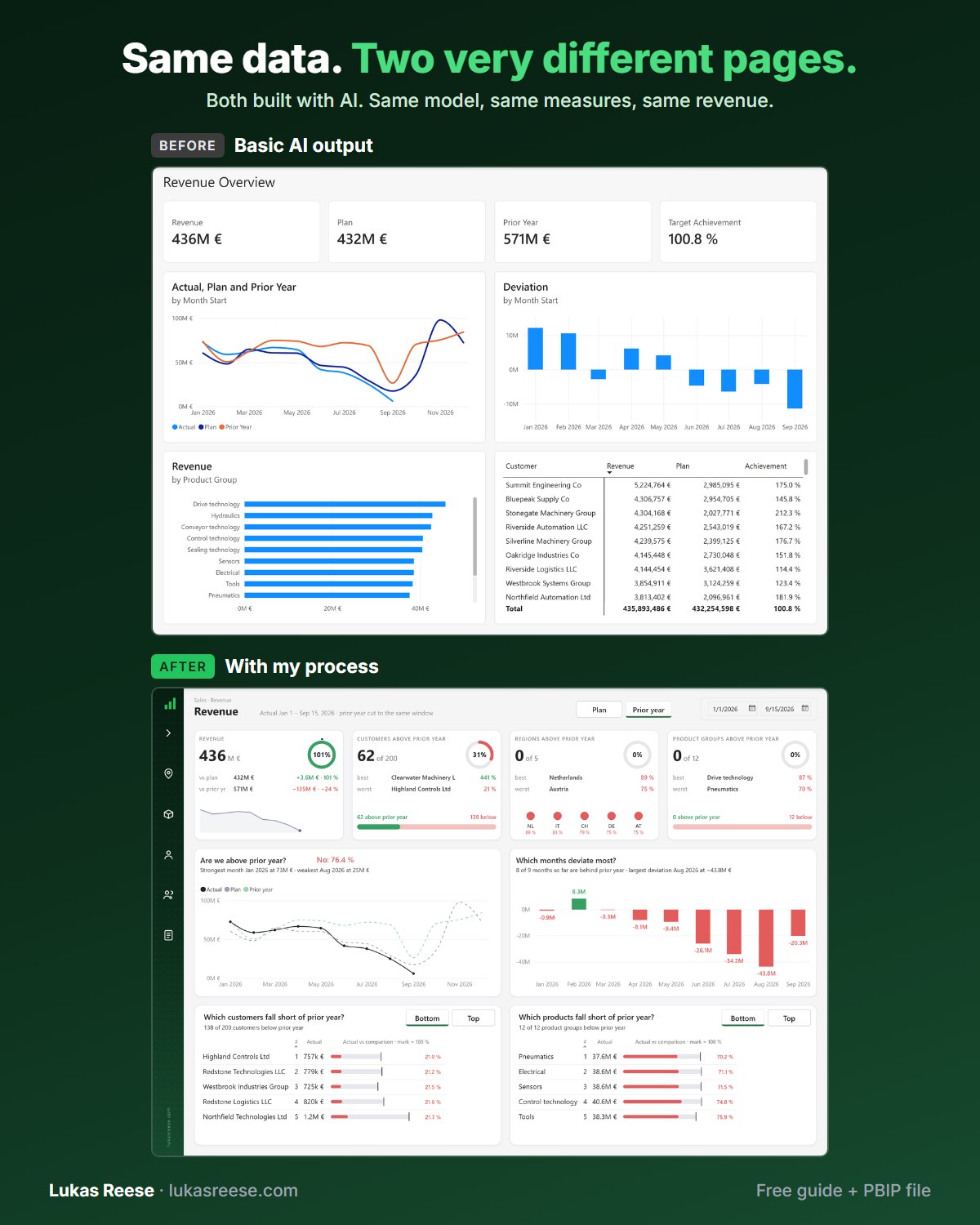
Same data, two very different pages. Both built with AI. This is the process behind the second one.
What you get:
- The 25-page guide: my full process, tool stack and 7 prompts you can copy
- The PBIP file with the same revenue page twice: the basic AI output and the finished page
- Step-by-step explanation, inspiration and real output.
Important: confirm your email
- After you sign up, you get a confirmation email. Click the button in it, then the guide and PBIP file are on their way.
powerbi-report-cli). Where this post says “report authoring skill”, that is now the authoring mode of the new skill. Read what changed: Power BI Report CLI: 4 Skills Merged Into 1.Key Takeaways
- No, AI will not replace Power BI developers, but the job I learned a few years ago genuinely does not exist any more.
- The measurable risk is displacement rather than replacement: being outpaced by someone who uses AI well.
- Stanford found employment for 22 to 25 year olds in AI-exposed occupations sitting about 19% below trend, driven by reduced hiring instead of layoffs.
- What still protects you is business context: your definitions, your rules, and knowing what good actually looks like.
- Because building is cheap now, the job has shifted towards validating rather than constructing.
Will AI Replace Power BI Developers? The Short Answer
No, and I have been using agentic tooling daily for months, so this is not a comfortable guess from the sidelines. However, the honest version is sharper than a flat no, because the role as it was taught three years ago has already quietly gone. Anyone whose job description was “turn this request into a dashboard” is doing something materially different now, whether or not they have noticed.
AI is not going to replace Power BI developers, but the job you learned a few years ago, it probably doesn’t exist anymore.
Meanwhile, the same argument is being made in adjacent fields. In July 2026 a Forbes Technology Council contributor put it plainly for software engineering: AI will not replace developers, but developers using AI may replace those who fail to adapt. That is precisely the shape of the risk for the future of Power BI developers too.
A client asked me this directly, so I recorded the long answer, including the parts that are less comfortable than a headline allows.
What the Employment Data Actually Shows
Almost nobody writing about this has looked for numbers, so here are some. Stanford’s Digital Economy Lab tracks employment across AI-exposed occupations, and its August 2026 update found that workers aged 22 to 25 in the most AI-exposed occupations now sit roughly 19% below where they would be had their employment kept pace with similarly aged workers in less-exposed roles. A year earlier that gap was about 15%.
Three caveats matter more than the headline, so I will state them rather than bury them. Firstly, those same researchers find no widespread, economy-wide displacement. Secondly, the decline comes from reduced hiring instead of people being let go. Thirdly, and most importantly for us, the study covers AI-exposed occupations broadly (software development prominently) and is not a study of Power BI developers. No BI-specific equivalent exists that I could find. Accordingly, treat it as the closest measured analogue for business intelligence jobs, not as proof about our field.
The Real Risk Is Displacement, Not Replacement
Displacement means losing your position not because the work disappeared, but because someone else now does it faster or cheaper with better tools, while the role itself carries on existing without you in it. Notably, that is a very different thing from a job being automated away, and it is far more common.
This is the version I genuinely worry about on behalf of people I talk to. Furthermore, the Stanford shape fits it exactly: nobody is marched out of the building, the door simply narrows at the point of entry. In other words, the danger is not that your employer replaces you with a model. It is that the next person they hire does your job with one.
If you don’t deal with AI, others will take over and take advantage of AI, and you simply stay behind.
My advice here is deliberately unexciting. Stay current, but do not chase every trend that appears on your feed. Most of them will be gone by the time you have finished reading about them. Pick the two or three tools that touch your actual daily work, learn them properly, and ignore the rest without guilt.
Can AI Replace Power BI Developers on Real Projects?
On the mechanical parts of the work, largely yes, and I use it that way every week. Measures, tables, relationships and column descriptions all come out quickly and mostly correctly. Agentic AI describes models that plan and execute multi-step work against real files and tools rather than only answering questions, which is what made this shift possible in Power BI specifically.
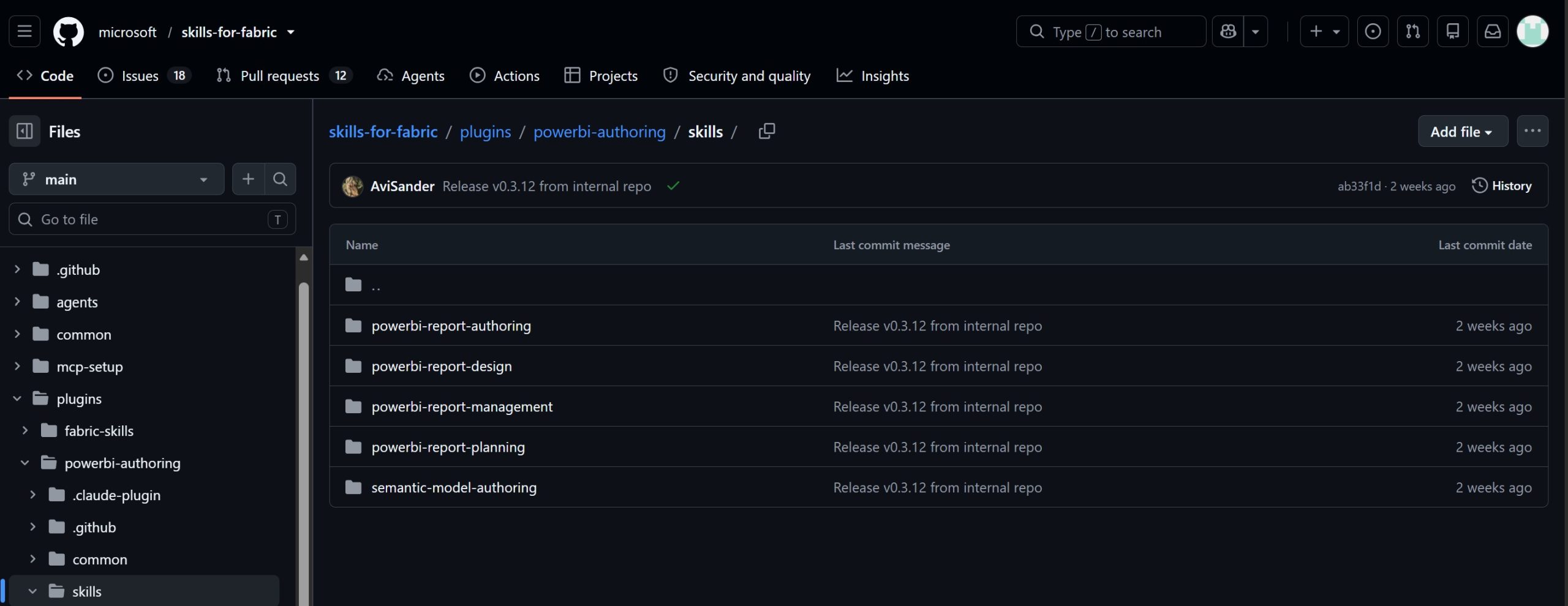
Where it earns its keep is scale. For example, one bookmark and three buttons is perfectly fine by hand, whereas twenty pages across five reports is not, and that is where I save the most time. Similarly, the shift from PBIX to the PBIP and PBIR formats is the unglamorous change that made any of it possible, and the Power BI report authoring skill is what I reach for daily. I mapped out where AI Power BI development actually sits today in my breakdown of the five levels of AI in Power BI development.
What AI Still Cannot Do: Your Business Context
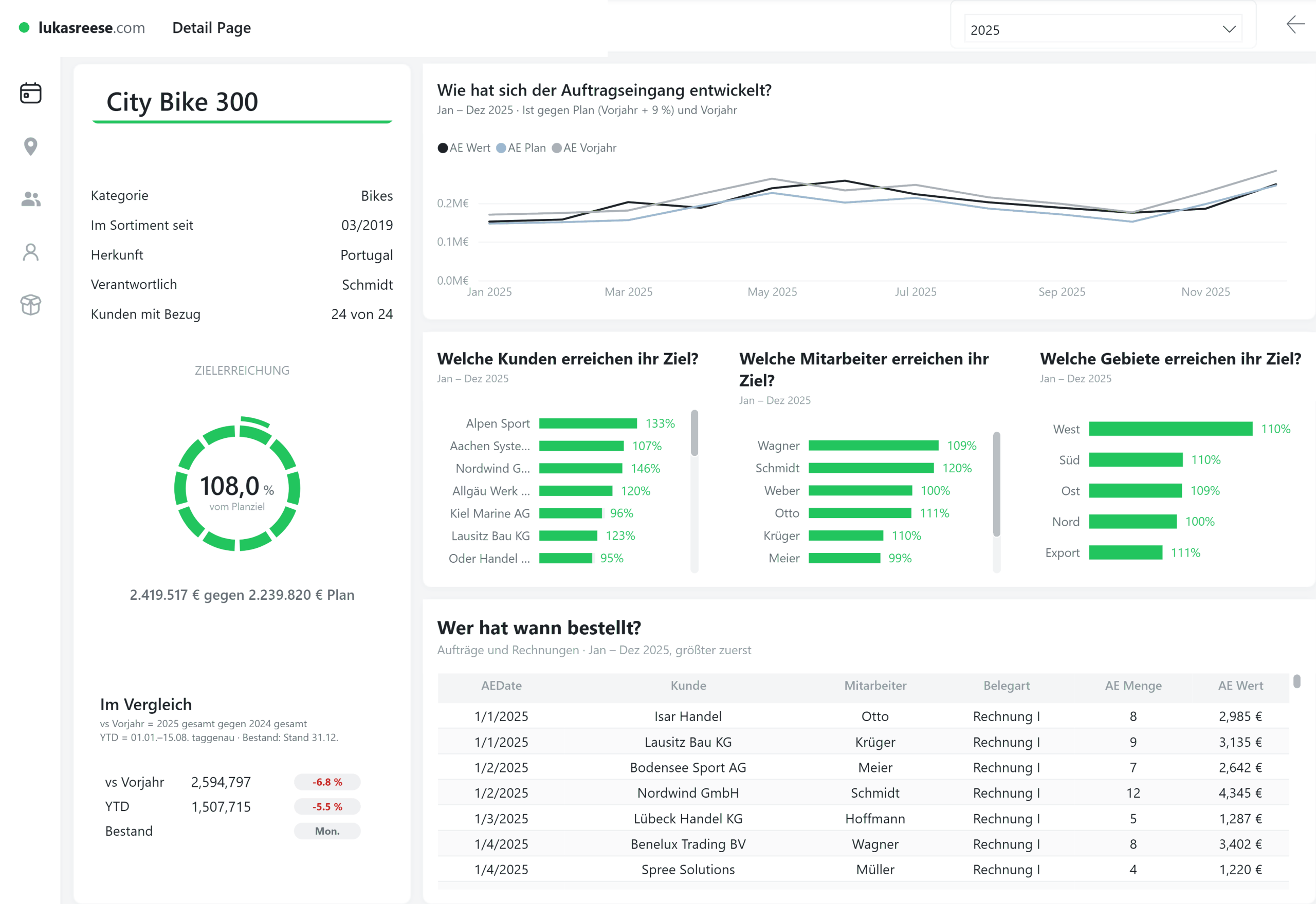
It builds fluently, and it does not know what any of it means. That gap is the whole argument, and it is what AI cannot do in Power BI today regardless of how good the output looks.
AI has a good way of creating reports, but it doesn’t know what good looks like.
Your definitions, your business rules and your design standards live outside the model. For example, two companies in the same industry will calculate churn differently, book revenue on different dates, and disagree about whether an internal transfer counts as a sale. None of that is written down anywhere a model can reach, and it is usually not written down at all: it lives in the heads of three people in finance.
Admittedly, teaching it more context genuinely helps, and I am not going to claim a permanent ceiling here. I would distrust anyone who did. Nevertheless, it does not replace the human instinct for what counts as good judgement. Somebody still has to decide what the word “revenue” means inside your company before a single figure is worth anything, and that somebody has to be accountable when the number turns out to be wrong.
Why This Is Not a Cost Argument
Underneath most replacement predictions sits an unexamined assumption: that you were hired because building dashboards was expensive. In effect, the whole argument collapses if that assumption is wrong, and it is wrong.
This is not a cost argument. The real reason is business context that keeps you in the job.
Building really has become cheap and fast, and yet my position has not weakened. Indeed, if cheapness had been the thing I was paid for, a template would have replaced me years ago, and free dashboard templates have existed for a decade without emptying the profession.
Consequently, the developers most exposed right now are the ones whose entire contribution was construction speed. Conversely, anyone whose value came from understanding the business well enough to challenge a requirement has lost nothing at all. That distinction is uncomfortable to say out loud, but it is the one that actually predicts who is worried and who is not.
The Bottleneck Moved From Building to Verifying
The constraint used to be how long a report took to build. Now it is how confident anyone can be that the output is correct.
It’s more validating and less building.
There is evidence for this, not just vibes. In an April 2026 evaluation, Copilot passed 62.5% of eight structured DAX tests in Power BI Desktop. Above all, the failures did not error: they returned answers that looked correct while skipping a prerequisite condition. That is exactly how a wrong number reaches a board pack. I made the full case for why this raises the value of fundamentals in my article on whether Power BI is still worth learning in 2026.
Want to sharpen the skills AI cannot replace?
DataCamp runs hands-on courses in Power BI, DAX and data modelling, the fundamentals that make verification possible. New users get a significant discount on their first subscription.
Explore DataCamp Courses →Where AI Adoption Actually Stalls
The hardest problem in agentic development right now is not capability. Rather, it is the distance between a prototype that works on my machine and something a company will actually approve.
Specifically, there are security standards to satisfy, data privacy rules to clear, and tooling restrictions that vary wildly between organisations. Not every company will grant model access at all, and in regulated industries the review can take longer than the project it was meant to accelerate. I have watched a workflow that took an afternoon to build sit unused for months waiting on an approval.
Therefore, on a great many teams the work is still done by hand, which is a mundane but real reason the role is not evaporating on the timeline the headlines suggest. Understanding how AI is changing the Power BI developer role means accounting for the companies where, for now, it has changed nothing at all. Moreover, the developer who knows both ways of working can move between those environments, whereas someone who only knows how to prompt cannot.
What Actually Protects Your Power BI Developer Job
Here is the honest split between what has been absorbed and what has not, based on how I work today.
| Part of the job | Absorbed by AI? | Who owns it now |
|---|---|---|
| Building visuals and page layout | Largely yes | AI, with review |
| Writing routine measures | Largely yes | AI, with review |
| Bookmarks and formatting at scale | Yes | AI |
| Data model design decisions | Partly | You, informed by AI |
| Deciding what a metric means | No | You, entirely |
| Stakeholder discovery | No | You, entirely |
| Validating that output is correct | No | You, entirely |
| Getting it approved in an enterprise | No | You and your security team |
Read the right-hand column and the pattern is obvious. Everything still yours is either business judgement or verification, so those are the Power BI developer skills worth investing in deliberately. If you want to test where your depth currently sits, my 73 Power BI interview questions are a blunt but useful check, and the business intelligence developer role covers the wider ground a Power BI developer career now touches.
Frequently Asked Questions
Will AI replace Power BI developers in the next few years?
No. However, the composition of the job changes substantially, because construction work is increasingly automated while validation and business judgement are not.
Will AI take my Power BI job if I do not use AI myself?
That is the realistic risk. Specifically, a peer using these tools well ships considerably faster, and over time that gap decides who gets the interesting work.
Can AI build a Power BI report without help?
It can build one that looks finished. Nevertheless, somebody has to confirm the figures are right, and in one 2026 evaluation Copilot passed only 62.5% of structured DAX tests.
What can a Power BI developer do that AI cannot?
Decide what a metric means for your business, run stakeholder discovery, and judge whether output is correct. Above all, none of that lives inside the model.
Are Power BI developer jobs actually declining?
No BI-specific study exists. Broadly, though, Stanford found early-career employment in AI-exposed occupations about 19% below trend, driven by slower hiring rather than layoffs.
What should I learn now to stay employable?
Learn the data model, filter context and DAX properly, since those are what make verification possible. I set out the full reasoning in why Power BI is still worth learning in 2026.
Last updated: 27 August 2026.